
The Election Commission of India has addressed reports of internal dissent among its commissioners and clarified that all Special Intensive Revision (SIR) orders and Form 6 updates for voter enrolment received unanimous consent and were upheld by the Supreme Court. The EC also announced measures to ease the process for voters issued notices, including doorstep document collection and extended deadlines in Delhi and Maharashtra, while affirming its commitment to transparent decision-making and meticulous compliance with directives.
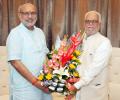
Newly elected Vice President C P Radhakrishnan met the Opposition's Vice-Presidential candidate retired Supreme Court Justice B Sudershan Reddy in New Delhi.

The Supreme Court has agreed to hear a Public Interest Litigation (PIL) next week that seeks the suspension of Chief Election Commissioner (CEC) Gyanesh Kumar and challenges the alleged unilateral decision-making within the Election Commission without the approval of two other Election Commissioners.

Maharashtra's Chief Electoral Officer has formally requested the Election Commission to modify the ECINet software, seeking greater discretion for Electoral Registration Officers in addressing over 2 crore voter discrepancies.

CJP spokesperson Ashutosh Ranka has reiterated the outfit's demand for CEC Gyanesh Kumar's resignation, alleging the exclusion of 13 crore names from electoral rolls and questioning the BJP's defence of Kumar. The CJP plans a nationwide protest starting October 2, vowing not to back down until Kumar resigns, and has launched the 'Election Commission Thik Karo' campaign. Ranka also accused the CEC of fraudulently redrawing constituencies in Assam to benefit the ruling party.

AISA national president Neha Bora was released at the Narela Industrial Area police station after being picked up during the organisation's protest march towards Jantar Mantar, with AISA members alleging procedural violations during her detention.

The Supreme Court has agreed to hear petitions challenging Section 16 of the Chief Election Commissioner and other Election Commissioners Act, 2023. This provision grants blanket immunity from civil and criminal prosecution to current and former CECs and ECs for actions taken in their official capacity. Petitioners argue this immunity is unconstitutional and broader than that afforded to other high-ranking officials, potentially undermining accountability.

Congress leader Rahul Gandhi urged CEC Gyanesh Kumar to resign and turn approver, stating the opposition's fight is against the "bigger powers" behind him.

Three BJP allies, including LJP (Ram Vilas), TDP, and RLM, have called on the Election Commission for a clearer explanation regarding concerns raised by two Election Commissioners over the voter list revision process. Union Minister Chirag Paswan warned that public faith in elections was at stake, while the EC asserted that differing views among its members were normal and final decisions were unanimous.

The Supreme Court has sought responses from the Election Commission and Chief Election Commissioner Gyanesh Kumar regarding a plea filed by Congress leader Rahul Gandhi and 12 other opposition leaders concerning alleged large-scale voter deletions and Special Intensive Revision (SIR) irregularities.

Abhijeet Dipke has issued a strong call to Indian opposition parties, urging them to boycott elections if they genuinely believe the electoral process is rigged, arguing that their continued participation only legitimises alleged unfairness.

India's Election Commission's centralised voter database systems, ERONET and ECINet, are under scrutiny following concerns raised by Election Commissioners Sukhbir Singh Sandhu and Vivek Joshi regarding the centralisation of electoral rolls and control available to state election officials. The article explains how these systems work and why they are currently in the news.

The INDIA bloc is set to convene on September 30 in New Delhi to formulate a unified strategy regarding the Election Commission, focusing on the removal of Chief Election Commissioner Gyanesh Kumar and concerns over the Special Intensive Revision of electoral rolls. The meeting will also address coordinated protests and the CEC selection process, bringing together diverse opposition parties.

The Cockroach Janta Party (CJP) has called for the resignation of Chief Election Commissioner Gyanesh Kumar, alleging he has 'undermined' voter rights by excluding over 13 crore names from draft electoral rolls across 30 states and Union territories during the Special Intensive Revision (SIR) exercise.
A petition has been filed in the Supreme Court challenging Chief Election Commissioner Gyanesh Kumar over alleged statutory duty violations and the controversial deletion of 13 crore voters during the Special Intensive Revision of electoral rolls, claiming decisions were made without the concurrence of other election commissioners.

Opposition MPs from the INDIA bloc, including prominent leaders like Rahul Gandhi and Priyanka Gandhi Vadra, marched to the Supreme Court to file a petition against Chief Election Commissioner Gyanesh Kumar, alleging 'vote chori' and irregularities in electoral rolls.

Trinamool Congress leader Saket Gokhale has accused the Election Commission of India (ECI) of withholding details about the software and algorithm used for the Special Intensive Revision (SIR) of electoral rolls. Citing an RTI response, Gokhale highlighted the ECI's claim that the information relates to "commercial confidence, trade secrets and intellectual property matters," raising concerns about transparency in the electoral process.

The Congress party has demanded the resignation of Chief Election Commissioner Gyanesh Kumar, alleging "vote chori" and treason, following a media report revealing that two other Election Commissioners had formally objected to decisions regarding the Special Intensive Revision of electoral rolls. Rahul Gandhi and Mallikarjun Kharge have accused the BJP, RSS, and EC of undermining democracy, citing concerns over voter list tampering and lack of transparency.

The Congress party has launched nationwide protests against Chief Election Commissioner Gyanesh Kumar, demanding his removal. Accusing him of acting in favour of the BJP and citing alleged irregularities in electoral roll revisions (SIR), party workers burned effigies and clashed with police. Opposition parties plan further action, including a meeting of the INDIA bloc to strategize for his ouster.

Opposition parties, led by Rahul Gandhi and Mallikarjun Kharge, plan to march to the Supreme Court on Monday to meet the Chief Justice of India. They aim to submit a memorandum regarding alleged 'vote chori' and demand CEC Gyanesh Kumar's resignation, halting of SIR, and a return to paper ballots. The protest follows widespread detentions during previous demonstrations, which the opposition condemns as an assault on democracy.

The Opposition India bloc has threatened to initiate impeachment proceedings against Chief Election Commissioner Gyanesh Kumar, citing alleged irregularities in the Special Intensive Revision (SIR) of electoral rolls. This move comes as the Opposition plans a joint agitation and highlights the constitutional process for removing a CEC, which mirrors that of a Supreme Court judge.

The INDIA bloc has formulated a joint action plan to address the Special Intensive Revision (SIR) row and concerns over Electronic Voting Machines (EVMs). Following a meeting of key opposition leaders, the alliance announced a series of "save democracy" marches, demonstrations, and a march to the Election Commission, demanding a return to ballot papers for elections and alleging electoral malpractices by the ruling government.

'If Gyanesh Kumar had some shame he would have resigned and would have taken agni pariksha.'

The Supreme Court stated it has not approved any modifications to Form 6, used for electoral roll inclusion, during the Special Intensive Revision. This observation came during the hearing of a Public Interest Litigation (PIL) challenging alleged unilateral decisions by the Chief Election Commissioner regarding changes to Form 6 and electoral roll revisions in states like Goa and West Bengal, without the concurrence of his colleagues. The court issued notice on the plea, highlighting concerns over collective decision-making within the Election Commission.

'If you ask Prime Minister Modi prove you are Indian, as per the Election Commission's criteria, he may not be able to prove that he is an Indian.'

Leaders of the opposition INDIA bloc met President Droupadi Murmu, alleging 'vote chori' and demanding the resignation of Chief Election Commissioner Gyanesh Kumar, along with the repeal of assembly polls from the last two years. Rahul Gandhi expressed shock that the President did not deny the 'election theft' charge but sought proof.

Easing Gyanesh Kumar out would create a hazardous political precedent because forcing out a top official, due to public pressure, projects an image of reactive, defensive governing. Furthermore, making a high-level official like the CEC to hand in his papers would validate Opposition claims that Constitutional referees have been compromised, observes Nilanjan Mukhopadhyay.

The Election Commission is set to announce the schedule for the Bihar legislative assembly elections on Monday. The announcement will be made at a press conference at 4 pm.
'Their functioning is flawed, they are not accountable, they are opaque, they are non-transparent, they have lost credibility.'

The Election Commission of India has prohibited the conduct and dissemination of exit polls from April 9 to April 29 during the upcoming assembly elections in several states. Violators face imprisonment or fines.

The Election Commission of India has issued directives to political parties and candidates in Kerala, restricting the publication of print advertisements on the eve and day of the Assembly elections without prior certification.

Chief Election Commissioner Gyanesh Kumar arrived in Bihar to review preparations for the upcoming assembly elections. The visit includes meetings with political parties, police, administrative officials, and state leaders to ensure smooth conduct of the polls. The visit follows the publication of the final electoral roll after a Special Intensive Revision, which has sparked controversy among political parties.
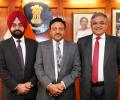
Newly appointed election commissioners Gyanesh Kumar and Sukhbir Singh Sandhu assumed charge on Friday.
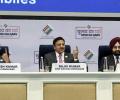
The Election Commission of India (ECI) has refuted allegations by the Aam Aadmi Party (AAP) that the Commission is being run by Chief Election Commissioner Rajiv Kumar. The ECI said it is a three-member body and has collectively noted "repeated deliberate pressure tactics" to malign the poll authority in the Delhi elections. The ECI has decided to exercise constitutional restraint and not be swayed by such insinuations. The AAP has alleged that the EC has been ignoring the BJP's alleged violations of poll code, and that Kumar is not taking action against the BJP to secure a post-retirement assignment. Delhi goes to polls on Wednesday.

The counting of votes for all 824 seats across four states and one Union Territory will be held on May 4.

The National Investigation Agency (NIA) has charge-sheeted eight more individuals in connection with a 2020 transnational narco-terror network case involving the smuggling of drugs from Pakistan to Gujarat, with the aim of financing the Lashkar-e-Taiba (LeT) terror group.
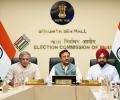
A selection committee headed by Prime Minister Narendra Modi will meet early next week to finalise the name of the next chief election commissioner. The panel will recommend a name from among the candidates shortlisted by a search committee. The president will then appoint the next CEC based on the recommendation. The panel comprises the Leader of the Opposition in Lok Sabha Rahul Gandhi and a Union Cabinet minister nominated by the prime minister.

On Wednesday, February 19, 2025, newly appointed Chief Election Commissioner Gyanesh Kumar took charge in New Delhi.

The announced election schedule for five assemblies reveals fewer phases, a condensed voting period, longer gaps between polling days, and a delayed counting process compared to previous elections.

The Election Commission has directed enforcement agencies and security forces to take proactive measures during the Bihar elections to prevent the use of drugs, liquor, and cash to influence voters.
